
The Sentimental Bloke (Raymond Longford, 1919) probably wr. Lottie Lyell, Raymond Longford, from poem/book by C.J. Dennis, dp Arthur Higgins; Arthur Tauchert, Lottie Lyell, Gilbert Emery, C.J. Dennis
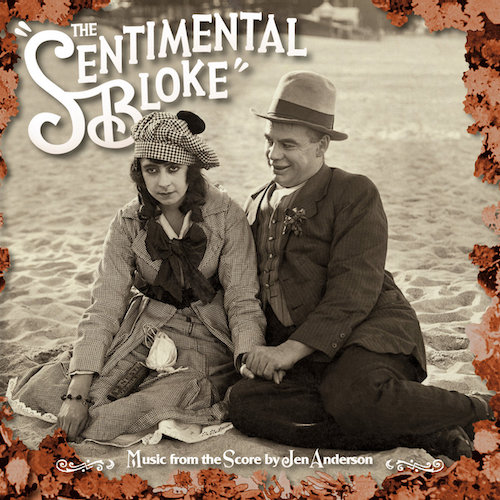
In this shot from the film, Doreen has on her lap a bar of Nestle's Nut Milk Chocolate.
Bill is a Woolloomooloo larrikin, who vows to abandon his life of gambling (playing Two-up) and drinking after a spell in gaol following a raid on a two up game. He falls in love with Doreen (Lyell), who works in a pickle factory, but faces competition from a more sophisticated rival, Stror 'at Coot.
Bill and Doreen argue, but are eventually reunited and get married. Bill gives up drinking and hanging out with his mate, Ginger Mick, and becomes a family man. He gets an offer from his uncle to manage an orchard in the country, and he and Doreen settle down there with their baby. Wikipedia.
One evening I saw a 1919 film and finished a 1933 book, in both of which I read the expression ‘got the hump’ which, afaik, has disappeared from Australian usage since WW2. The film is Lottie Lyell & Raymond Longford’s, based on C.J. Dennis’s Songs of a Sentimental Bloke (A&R, 1915). In my family copy of the 1932 reprint (which cost 2/9) the glossary says that ‘the hump’ is ‘a fit of depression’. The other book is John K. Ewers’ Money Street, which I’ve been getting around to reading for most of my life, knowing that the eponymous street was only a couple of miles from where I grew up.
The fortuitous survival of a single nitrate print enabled the film to be preserved at the National Film and Sound Archive in the 1950s. Its subsequent rediscovery by film societies and other groups brought Longford some belated recognition in his old age. The film is internationally regarded as a classic, and interest in it is such that, in Australia alone, non-theatrical film libraries have dozens of prints in constant circulation. Pike & Cooper: 91.
Darragh O'Donoghue:
Lottie Lyell had her work cut out when she agreed to appear as the love interest of The Sentimental Bloke (Raymond Longford, 1919). The film was, and has usually been admired, as a bloke-ish affair. Its reputation – it was the highest grossing Australian film during the silent era, and has been called the ‘Great Australian Film’ – has been attributed to its (male) director. Raymond Longford is revered as “the only genuine creative talent the Australian cinema has produced” and “a remarkable filmmaker” with “unique vision”. His characteristic fusion of high Victorian melodrama, natural light and outdoor shooting, pacy realism, and dynamic cinematic techniques, led to comparisons with D.W. Griffith, then the most famous film director in the world. ...
A talkie with this title was directed by Frank W. Thring, and released in 1932.
Boyd, David 1998, 'The public and private lives of a Sentimental Bloke,' Cinema Journal, Volume 27, Issue 4 (Summer): 3.
O'Donoghue, Darragh 2023, 'The Sentimental Bloke', Sense of Cinema, September.Pike, Andrew & Ross Cooper 1998, Australian Film 1900-1977: A Guide to Feature Film Production, OUP, Melbourne: 89-91.
Reade, Eric 1975, The Australian Screen: A Pictorial History of Australian Film-making, Lansdowne Press, Melbourne: many pages, eg 90-91.
Shirley, Graham and Brian Adams 1989, Australian Cinema: The First Eighty Years, Currency Press: 54-58.
Shirley, Graham, 2009, 'How the NFSA restored and re-released 'The Bloke', NFSA.
Wikipedia page.
Garry Gillard | New: 19 October, 2012 | Now: 5 November, 2023